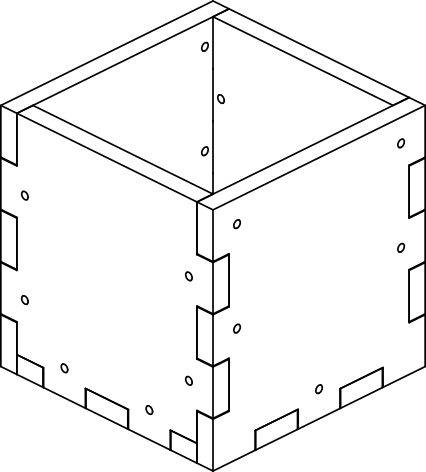
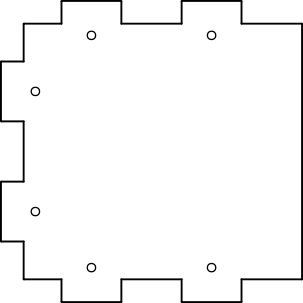
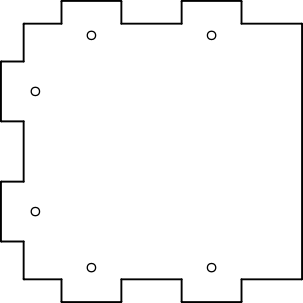
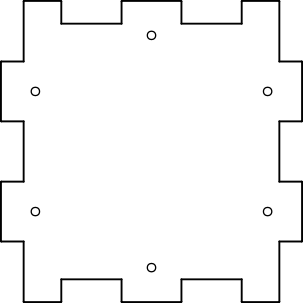
The fingers line each corner up and a waxed cord clamps it. There’s no glue, no screw and nothing with a thread on it, so the box comes apart by untying it.
Thin board runs out of fastenings fast. A nut needs room to hide in the board’s thickness, a screw splits a thin edge, and glue wants long grain and a clean surface, which hardboard doesn’t have and a laser chars over. Tension works at any thickness.
The cord sets everything else. A 1 mm cord passing a hole twice needs a 2.4 mm hole, the hole needs wood around it, and that sets the smallest box the joint can lace. The top stays open because every stitch is threaded from both sides, so the last corner needs a hand inside it.
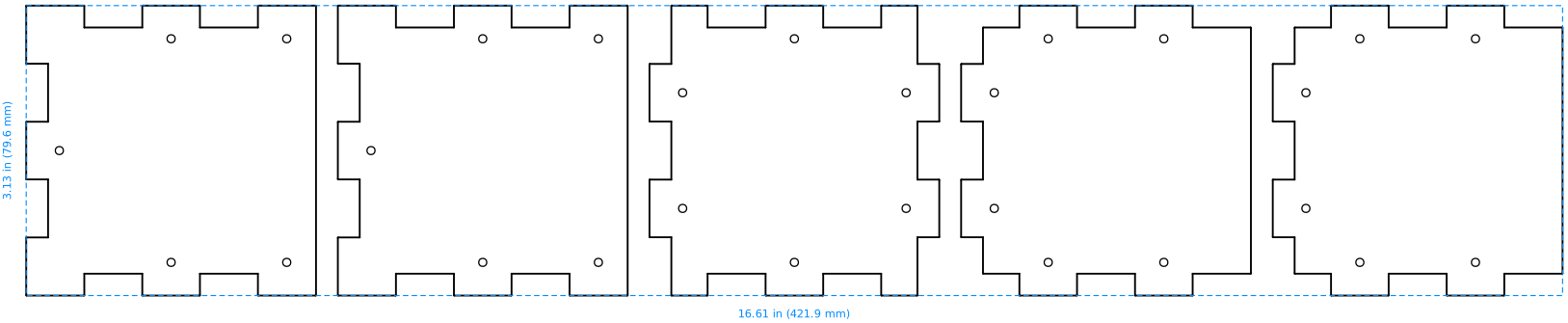
One Python file builds the panels as solids with build123d, checks that no two boards share a cubic millimetre, and writes the cut files, the build sheet and this drawing from the same model. No number is typed twice.
Revisions
small-a
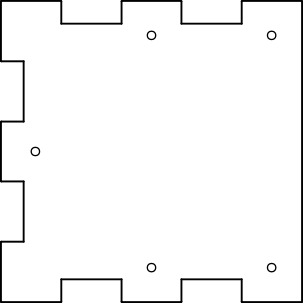
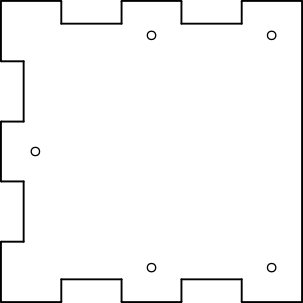
October 2026. A 3-1/8 in cube in 1/4 in baltic birch, every panel cut from inside a 3-1/4 in square. Not cut yet. The first cut is a test of whether 2.4 mm holes stay round enough through 6 mm ply to pass the cord twice, and whether the top stitch holds 6.8 mm from the rim.
Build sheet, with the cut list, the lacing chart for every corner and the build sequence.
rev-a
August 2026. A 240 x 160 x 120 mm tote in 1/8 in tempered hardboard, sized to hold A5 notebooks upright.