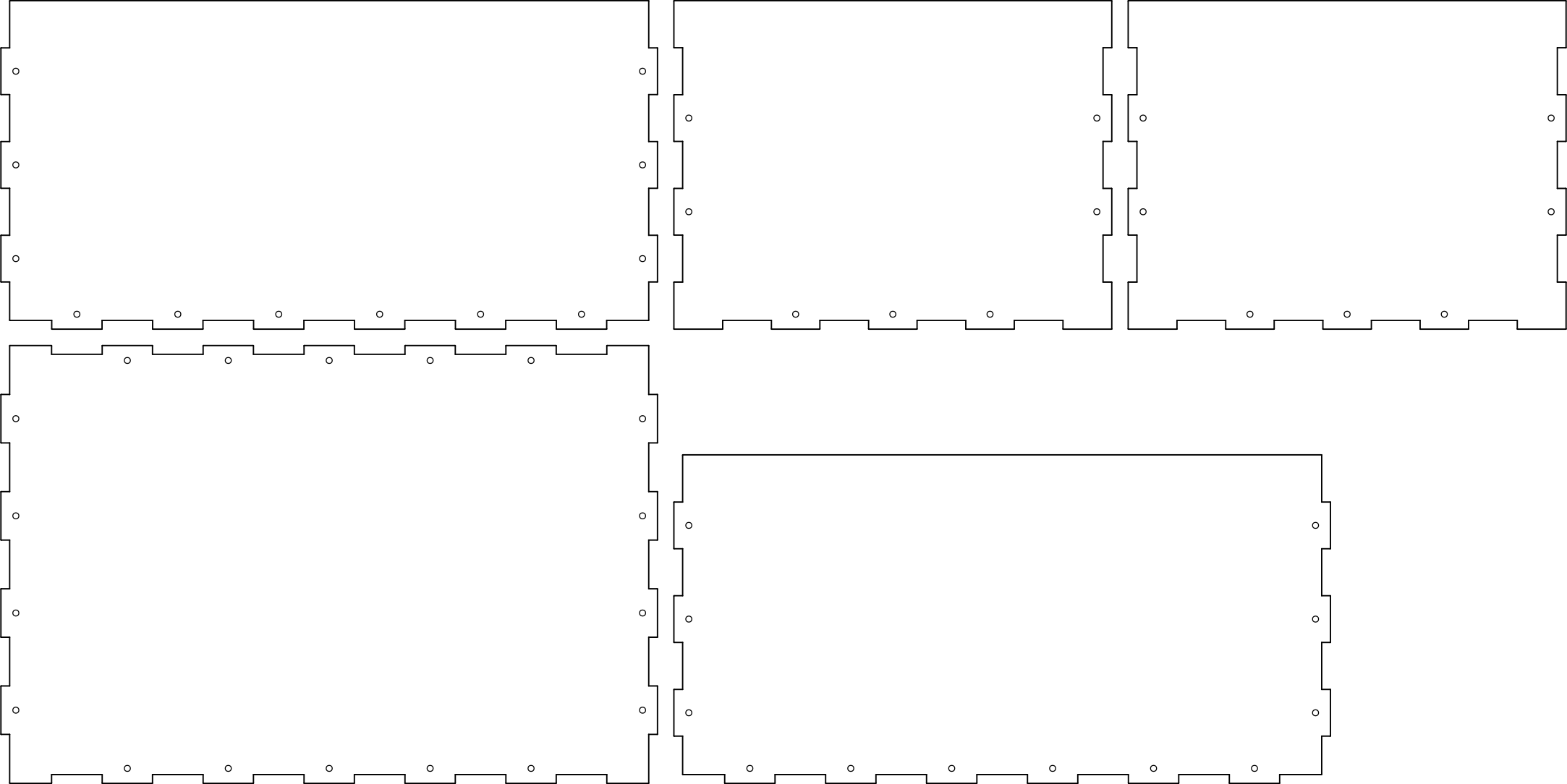
9-7/16" x 4-23/32" x 6-5/16" outside, 5 panels, 4.6 m of cord, no glue.
Looking down. Open top: the lacing needs a hand inside the last corner.
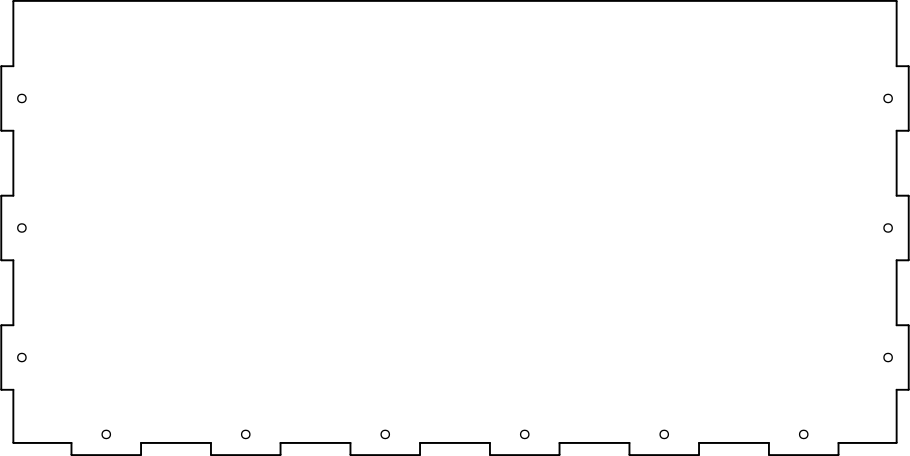
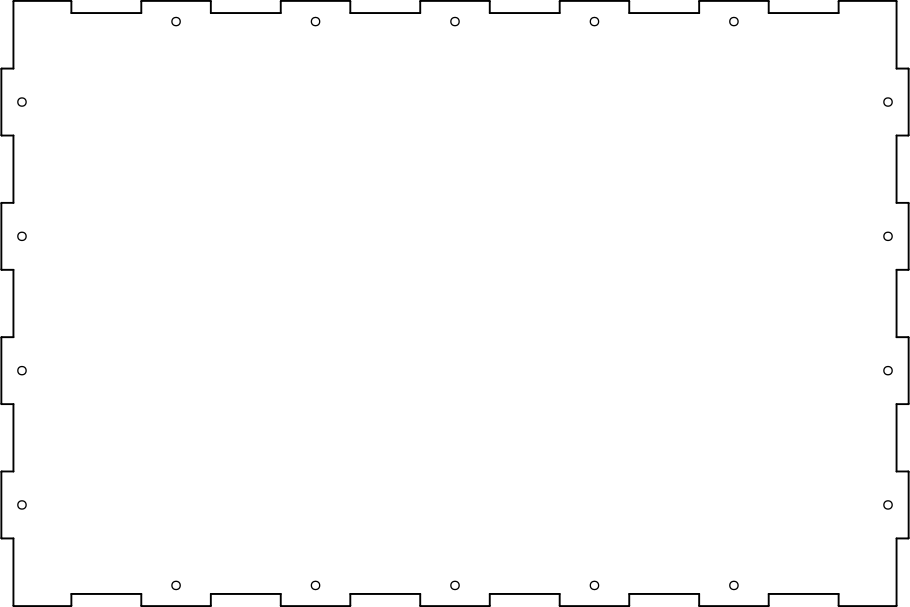
Hidden-line projection of the real solids. The lace holes sit inboard of the finger roots, where both boards are solid the whole way along.
| Part | Qty | Length | Width | Thick | Lace holes |
|---|---|---|---|---|---|
| BOTTOM | 1 | 9-7/16" (240.0 mm) | 6-5/16" (160.0 mm) | 1/8" (3.2 mm) | 18 |
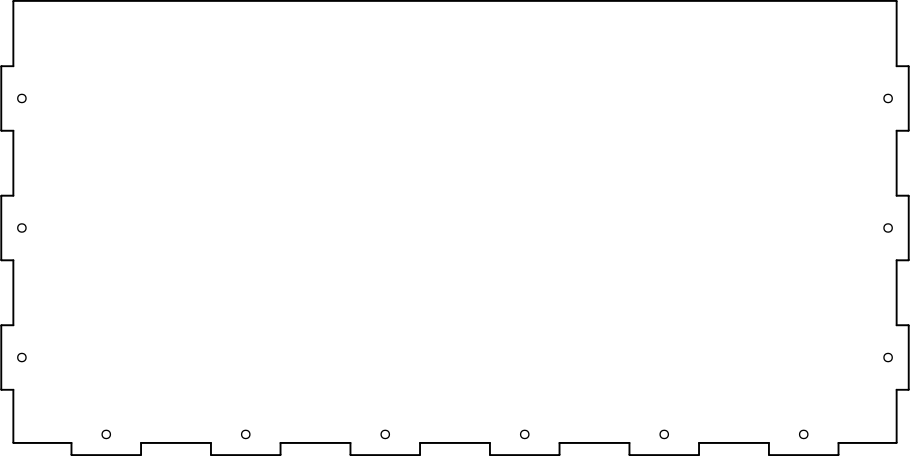
| FRONT, BACK | 2 | 9-7/16" (240.0 mm) | 4-23/32" (120.0 mm) | 1/8" (3.2 mm) | 12 |
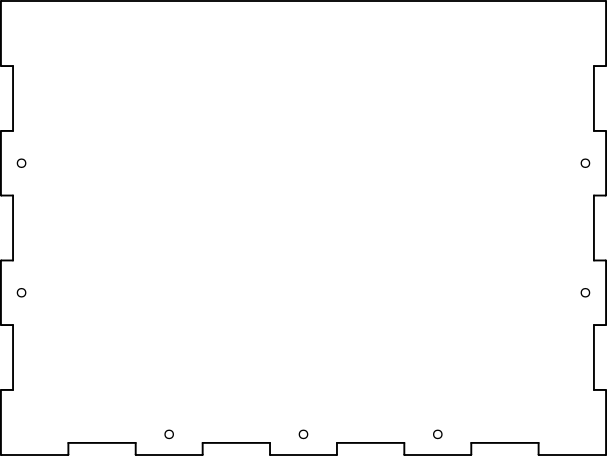
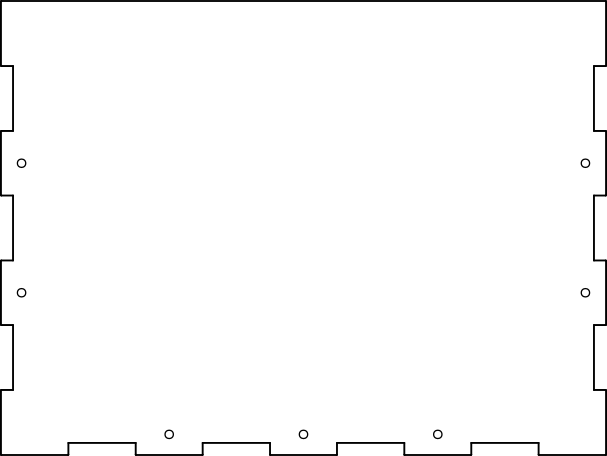
| LEFT, RIGHT | 2 | 6-5/16" (160.0 mm) | 4-23/32" (120.0 mm) | 1/8" (3.2 mm) | 7 |
Every panel is 1/8" (3.2 mm) hardboard_eighth. Cut to the mm; the fraction is a cross-check.
| Qty | Unit | Part | Kind |
|---|---|---|---|
| 4576 | mm | cord_poly_1_0 | cord |
The cord is bought by the metre, so the bill totals a length rather than a count. Buy a spool: 4.6 m is what this box needs and a knot goes wrong.
Thread every hole in order. The side alternates on its own: solid is the first pass going over the outside, dashed is where it comes back inside, and the second pass takes the other side of each leg. 11 holes along the width, 10 crossings. BOTTOM’s holes are 7/32" (5.4 mm) from the arris and FRONT’s are 7/32" (5.4 mm). Cut 765 mm of cord for this corner.
Thread every hole in order. The side alternates on its own: solid is the first pass going over the outside, dashed is where it comes back inside, and the second pass takes the other side of each leg. 5 holes along the height, 4 crossings. FRONT’s holes are 7/32" (5.4 mm) from the arris and LEFT’s are 7/32" (5.4 mm). Cut 476 mm of cord for this corner.
| Corner | Crossings | Cord |
|---|---|---|
| BOTTOM/FRONT | 10 crossings zigzagged | 765 mm |
| BACK/BOTTOM | 10 crossings zigzagged | 765 mm |
| BOTTOM/LEFT | 6 crossings zigzagged | 571 mm |
| BOTTOM/RIGHT | 6 crossings zigzagged | 571 mm |
| FRONT/LEFT | 4 crossings zigzagged | 476 mm |
| BACK/LEFT | 4 crossings zigzagged | 476 mm |
| FRONT/RIGHT | 4 crossings zigzagged | 476 mm |
| BACK/RIGHT | 4 crossings zigzagged | 476 mm |
laser/sheets/. Inner features run before outlines, so every panel is still held in the sheet while its share of the 56 lace holes is cut.| Check | Result | Measured |
|---|---|---|
| the loop solves and nothing clashes | pass | 5 boards, no pair shares a cubic millimetre |
| the box stays open somewhere | pass | 5 faces: the lacing needs a hand inside the last corner, so a closed box cannot be sewn shut from outside |
| kerf compensation runs the right way through a hole | pass | measured 2.4000 mm vs 2.4000 mm — error 4.44e-16 mm (tolerance 1e-06) |
| the hole that comes off the machine passes the cord twice | pass | 2.20 mm path + 0.2 mm kerf = 2.40 mm hole, against 2 mm of cord: 0.40 mm to thread with |
| LEFT fits the bed | pass | 160.0 x 120.0 mm on a 600 x 300 mm bed |
| RIGHT fits the bed | pass | 160.0 x 120.0 mm on a 600 x 300 mm bed |
| FRONT fits the bed | pass | 240.0 x 120.0 mm on a 600 x 300 mm bed |
| BACK fits the bed | pass | 240.0 x 120.0 mm on a 600 x 300 mm bed |
| BOTTOM fits the bed | pass | 240.0 x 160.0 mm on a 600 x 300 mm bed |
| cord to buy | 4.6 m | 8 corners, 150 mm a tail at each end |
| stitches | 48 | crossings in total, each threaded twice over |
| the hardboard_eighth nest stays on the bed | pass | 5 parts inside 578.6 x 292.4 mm |
Plus the frame’s own: every joint’s conscience, and the assertion that no two boards share a cubic millimetre.
| From the frame | Result | |
|---|---|---|
| laser can cut hardboard_eighth (flat on the bed, cut straight through) | pass | |
| FRONT/LEFT finger count 7 is odd (one program serves both ends) | pass | |
| lace hole clears LEFT by 0.96 mm, so it opens into the box rather than dead-ending in the socket | pass | |
| lace hole 2.4 mm passes cord_poly_1_0 twice (2.0 mm of cord) | pass | |
| FRONT/LEFT: 5 holes over 120 mm, alternating board to board | pass | |
| BACK/LEFT finger count 7 is odd (one program serves both ends) | pass | |
| BACK/LEFT: 5 holes over 120 mm, alternating board to board | pass | |
| BOTTOM/LEFT finger count 9 is odd (one program serves both ends) | pass | |
| BOTTOM/LEFT: 7 holes over 160 mm, alternating board to board | pass | |
| FRONT/RIGHT finger count 7 is odd (one program serves both ends) | pass | |
| lace hole clears RIGHT by 0.96 mm, so it opens into the box rather than dead-ending in the socket | pass | |
| FRONT/RIGHT: 5 holes over 120 mm, alternating board to board | pass | |
| BACK/RIGHT finger count 7 is odd (one program serves both ends) | pass | |
| BACK/RIGHT: 5 holes over 120 mm, alternating board to board | pass | |
| BOTTOM/RIGHT finger count 9 is odd (one program serves both ends) | pass | |
| BOTTOM/RIGHT: 7 holes over 160 mm, alternating board to board | pass | |
| BOTTOM/FRONT finger count 13 is odd (one program serves both ends) | pass | |
| lace hole clears FRONT by 0.96 mm, so it opens into the box rather than dead-ending in the socket | pass | |
| BOTTOM/FRONT: 11 holes over 240 mm, alternating board to board | pass | |
| BACK/BOTTOM finger count 13 is odd (one program serves both ends) | pass | |
| lace hole clears BOTTOM by 0.96 mm, so it opens into the box rather than dead-ending in the socket | pass | |
| BACK/BOTTOM: 11 holes over 240 mm, alternating board to board | pass | |
| no two of 5 parts occupy the same space | pass |
5 panels in hardboard_eighth (3.2 mm), laser, kerf 0.2 mm, cord cord_poly_1_0 (1 mm). Shop: /Users/joel/repos/parametric-studio/shop.py. 10 of 10 checks passed.